
Bulgaria is closer to having a unified, digital public transport system than it may appear.
Over the past three years, a foundational layer has been taking shape — one that can enable national journey planning, multimodal mobility, and integrated ticketing.
At the centre of this effort is Tripco.
The Starting Point: A System Without Structure
Public transport in Bulgaria operates across multiple modes — bus, rail, air, and water — managed by different operators, using different formats, and often lacking standardisation.
The result:
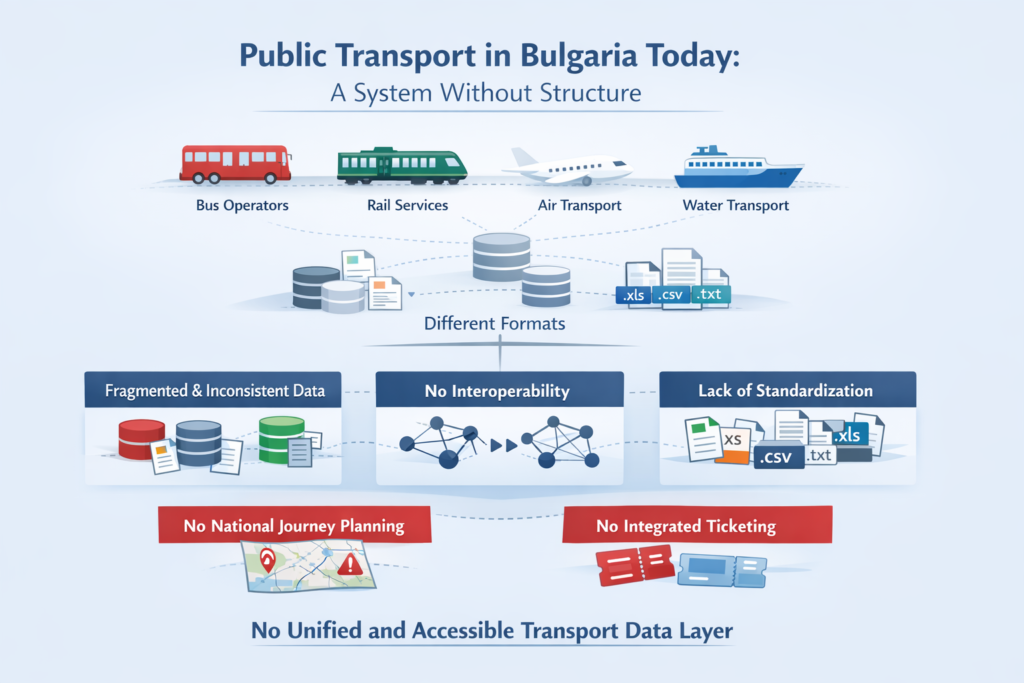
Fragmented and inconsistent data
Limited interoperability between operators
No unified system for journey planning
Barriers to digital ticketing and multimodal services
Despite European frameworks such as NeTEx and the requirements for National Access Points (NAPs), Bulgaria still lacks a structured and accessible national transport data layer.
A Key Milestone: The First National NeTEx Dataset
Tripco reached an important milestone.
With the support of Stefan de Konink, we began working with the first standardised NeTEx dataset covering the national bus network in Bulgaria.
This was a critical step forward, but it also revealed a key challenge:
Schedules alone are not enough.
Without structure, validation, and geographic context, transport data cannot power real digital services.
Building the Missing Layers
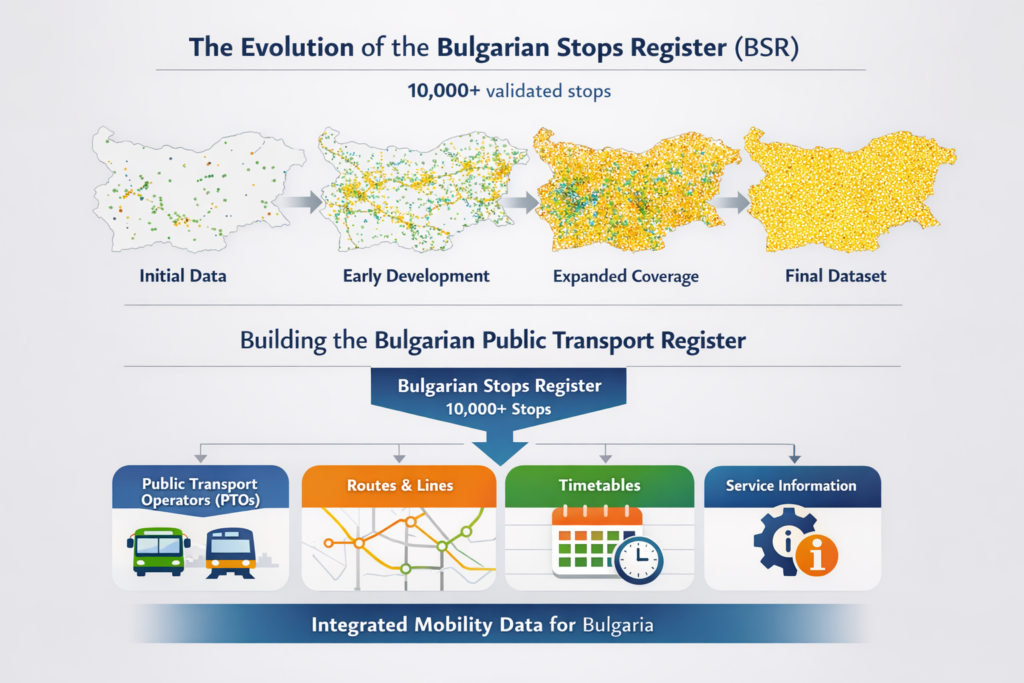
To address this, Tripco focused on two core components:
Bulgarian Public Transport Register
A structured, NeTEx-compliant dataset of:
- Routes
- Timetables
- Operators
It transforms fragmented schedule data — often from hundreds of Excel files — into a harmonised, machine-readable system. It is now expanding beyond bus to include rail, air, and water transport.
Bulgarian Stops Register (BSR)
A national database of transport access points, providing:
- Verified stop locations
- Geographic coordinates
- Standardised identifiers
The BSR connects transport services to real-world locations. Without it, schedules remain abstract and unusable for journey planning.
From Data to System
Individually, these registers are valuable. Together, they form the foundation of Bulgaria’s first complete national transport scheme.
By linking stops, routes, and timetables, Tripco has created a structured framework that can support:
- National journey planning
- Multimodal mobility
- Integrated digital ticketing
The Institutional Gap
These systems have been developed without institutional funding or formal integration, despite ongoing efforts to engage with Ministry of Transport and Communications and other public bodies.
This reflects a broader challenge:
Innovation in transport infrastructure often moves faster than institutional processes, while long-term success depends on alignment between them.
Why This Matters
Structured transport data is the basis for:
- More accessible public transport
- Better regional connectivity
- Increased use of sustainable mobility
- A modern passenger experience
In practical terms, this enables:
- Planning journeys across multiple modes
- Access to accurate, real-time information
- Integrated digital ticketing
Looking Forward
Tripco remains committed to supporting the development of Bulgaria’s transport ecosystem.
The goal is clear:

A unified national journey planner
Seamless multimodal integration
A connected transport experience
The foundation is already in place.
The next step is collaboration.